The Generals Have No Clothes: The Untold Story of Our Endless Wars by William M. Arkin
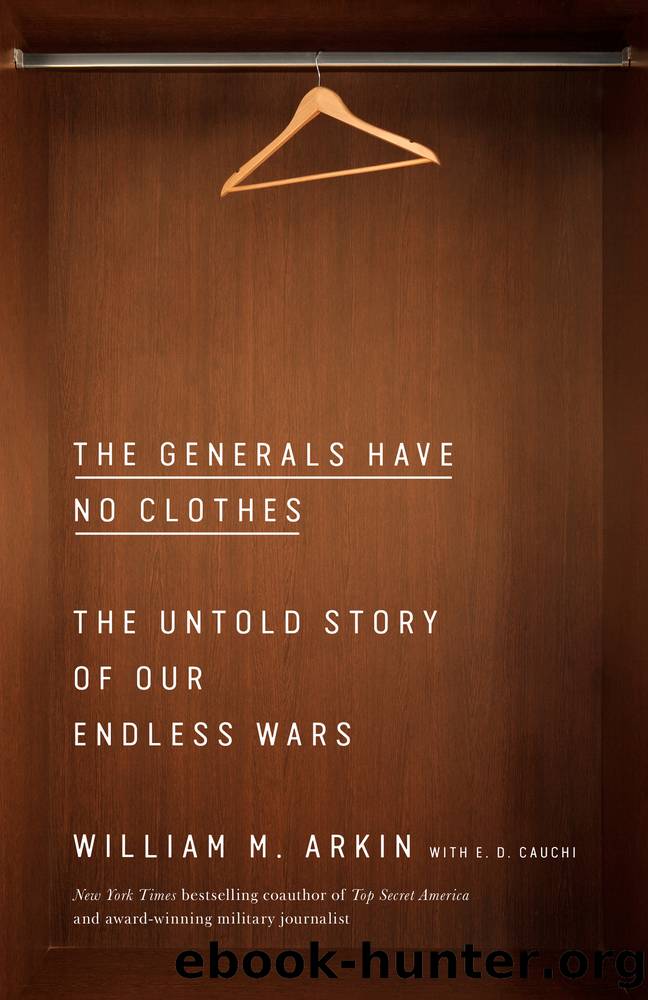
Author:William M. Arkin [Arkin, William M.]
Language: eng
Format: epub
ISBN: 9781982131012
Google: DvztDwAAQBAJ
Publisher: Simon & Schuster
Published: 2021-04-12T23:00:00+00:00
chapter eleven
CIVILIAN CONTROL OF THE MILITARY
Barack Obamaâs lack of national security credentials and his absence of military experience didnât seem to be a factor with the voting public in the 2008 election. Like Bill Clinton, who had defeated two World War II veterans in 1992 and 1996, Obama handily beat a war hero, retired Navy captain John McCain, to become president. Still, ongoing terrorist threats to the United States, and the ascendancy of the national security establishment itself, made the new president feel he needed to prove that, despite his lack of personal knowledge of combat, he had national security covered.
Obama chose retired Marine Corps general James L. Jones to be his national security advisor. âGentleman Jim,â as Jones was nicknamed, was in some ways a perfect match for the rookie president: wonky and understated, with a reputation for being respectful to everyone. But Obama hadnât even met Jones until two weeks before he was elected. According to the account by journalist Bob Woodward, Jones âwas astounded that the president-elect would give such a position of responsibility and trust to someone he hardly knew.â
Then came retired Navy admiral Dennis C. Blair, a former Rhodes Scholar, described by some as one of the smartest men ever to wear the uniform. Obama asked Blair to be his director of national intelligence. Blair had met Obama only once, and he too was âastonishedâ that the president-elect would select him to lead the entire intelligence community.
For Secretary of Defense, Obama implored Robert Gates, the very epitome of the national security establishment, to stay on from the Bush administration. Gates had been telling everyone who would listen that wartime was no time for a learning curve, opining that the first presidential transition in war since 1968 augured grave threats. But he also wrote that he had only met the young Illinois senator once and, being a Republican, had barely âcrossed pathsâ with most Obama insiders. Consequently he thought himself an odd choice to join the new presidentâs cabinet.
Leon Panetta, whom Obama asked to be CIA director, also didnât know the president. But he was a Washington fixture and an experienced manager, and Obama told him that only a savvy insider like him would be able to ârestoreâ the credibility of an agency that he thought had âbadly damaged Americaâs standing in the worldâ through its post-9/11 pursuits of torture and secret prisons.
With perhaps the exception of Panetta, who had served as Bill Clintonâs White House chief of staff, all of the appointments represented defensive moves. Obama reasoned that his quartet of heavy hitters would show Americaâs enemies that there would be no major disruption but also that he could be trusted on national security. Obama told Gates that he wanted âcontinuity and stabilityâ on national security, particularly so that he could focus on economic recovery from the 2008 market collapse. The president thought that retired general Jones would âgive him someone outside the Pentagon to deal with the secretary of defense and the generals on a more or less equal footing.
Download
This site does not store any files on its server. We only index and link to content provided by other sites. Please contact the content providers to delete copyright contents if any and email us, we'll remove relevant links or contents immediately.
| Anthropology | Archaeology |
| Philosophy | Politics & Government |
| Social Sciences | Sociology |
| Women's Studies |
The Secret History by Donna Tartt(19311)
The Social Justice Warrior Handbook by Lisa De Pasquale(12227)
Thirteen Reasons Why by Jay Asher(9009)
This Is How You Lose Her by Junot Diaz(6963)
Weapons of Math Destruction by Cathy O'Neil(6371)
Zero to One by Peter Thiel(5875)
Beartown by Fredrik Backman(5848)
The Myth of the Strong Leader by Archie Brown(5552)
The Fire Next Time by James Baldwin(5508)
How Democracies Die by Steven Levitsky & Daniel Ziblatt(5276)
Promise Me, Dad by Joe Biden(5192)
Stone's Rules by Roger Stone(5133)
A Higher Loyalty: Truth, Lies, and Leadership by James Comey(5020)
100 Deadly Skills by Clint Emerson(4975)
Rise and Kill First by Ronen Bergman(4841)
Secrecy World by Jake Bernstein(4805)
The David Icke Guide to the Global Conspiracy (and how to end it) by David Icke(4776)
The Doomsday Machine by Daniel Ellsberg(4557)
The Farm by Tom Rob Smith(4556)
